Front-page news
Demographics & statistics
5 min
Greater access to higher education does not necessarily guarantee more jobs or more wealth

By Laetitia Aroichane
Published in July 2025, Paxter’s global comparative study, Higher Education, Revenue & Employability, challenges a widely held belief: expanding access to higher education does not automatically guarantee more jobs or wealth. The research analyses economic, demographic, and educational data from 140 countries, representing 90% of the world’s youth. An analysis reported by Global Focus, the magazine of the European Foundation for Management Development (EFMD), in its Vol. 20 Issue 01-2026.
Results show that while HE development clearly supports wealth increase in low-income countries, this effect is not observed in developed countries, where employability does not depend on higher education access, but primarily on the relevance of qualifications and the suitability of training programmes to economic needs.
More education for more growth: for decades, this logic has guided education policies around the world. Raising education levels was seen as the surest lever for economic and social progress. More graduates meant less unemployment, higher productivity, and more growth. It was taken for granted that wider access to higher education was the key to prosperous and collective economic development. But is this really the case? What happens when accumulating qualifications no longer translates into better job prospects and instead leads to frustration among younger generations?
The global study conducted by PAXTER, a Paris-based academic strategy and educational engineering consultancy, explores these issues. Higher education, revenue & employability: a global comparison, by Pierre Aliphat, Nikola Damjanovic and Pierre Tapie, published in July 2025, is based on economic, demographic and educational data from 140 countries, representing more than 90% of the world’s youth. The study highlights unexpected correlations between economic development, access to higher education, and employability. The authors’ conclusions challenge certain assumptions and invite us to rethink the foundations of education policy in many countries.
More Access to Higher Education = More Wealth and More Jobs?
The study shows that while education remains essential in the early stages of economic development, it no longer guarantees prosperity once a certain development threshold has been reached (approximately $15,000 per capita, ppp). Thus, a country’s development is fuelled not only by knowledge, but also by the alignment between knowledge and the real needs of its economy. The key is consistency between training, skills, and labour market needs.
The development of higher education has long been considered an end in itself. Educational progress was measured according to the rate of access to university for a given generation, based on the implicit assumption that ‘more access = more employment’. However, in many countries, unemployment affects graduates more than non-graduates. It should be remembered that at the time of the Arab Spring in 2011, on the southern shore of the Mediterranean, unemployment rates among young graduates exceeded the national average of the youth by 50% more. More knowledge, but fewer jobs? This contradiction was the starting point for PAXTER’s research.
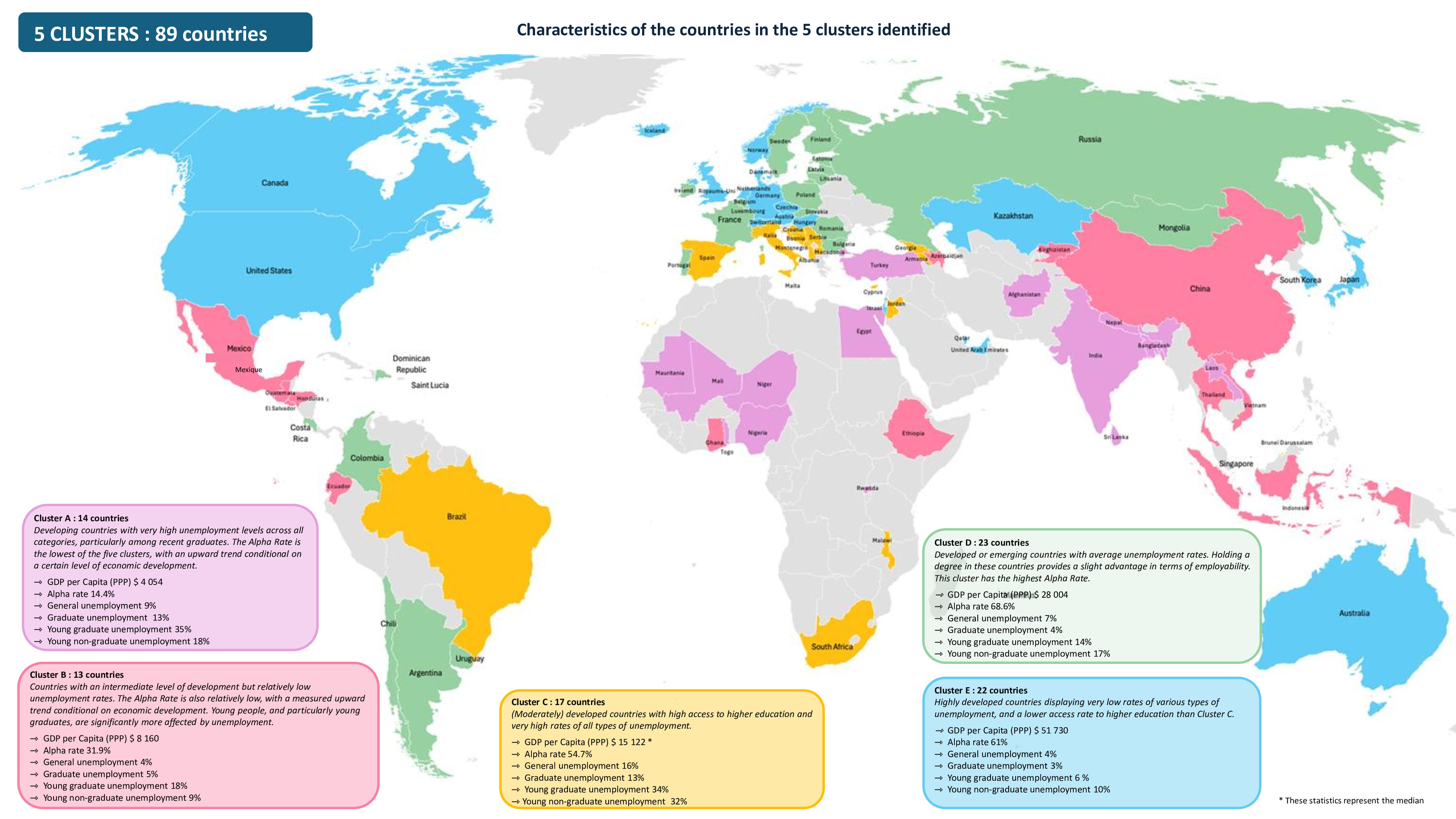
Identifying and Comparing Data: Results Classify Countries in Five Clusters
Continuing their exploration, the authors compiled and analysed international databases by cross-referencing several variables: GDP per capita in purchasing power parity (GDP/Capita (PPP)), the rate of access to higher education, and six unemployment rates (general, graduates, non-graduates, young people, young graduates, and young non-graduates). By use of non-directed algorithms, the authors thus paint a nuanced and surprising picture of the links between qualifications, employment, and wealth, identifying five groups of countries with similar dynamics ‘clusters’ based on their economic development. > Read the rest of the article on the blog of Global Focus, the EFMD Business Magazine
 > Read the article in PDF
> Read the full PAXTER's study and the synthesis
Photo : © EFMD for Global Magazine / iStock Photos
By Laetitia Aroichane
All topics
- France: future, opportunities & strategy
- Cost & financing
- Demographics & statistics
- Qualifications & accreditations
- Higher education institutions & Territories
- Equality
- Teaching, Pedagogy & Digital technology
- Environment & CSR
- Lifelong education and training
- Laws & Regulations
- Labour market, Professionalisation & Entrepreneurship
- International mobility & Attractiveness
- Higher education worldwide
- Research & Innovation
- Secondary education & Access to higher education
Most popular
-
“Higher education, revenue & employability”: discover the Paxter's groundbreaking global study
- “Higher education, revenue & employability”: Paxter to release a groundbreaking global study
-
Synthesis of the study “Higher Education, Revenue & Employability: A global comparative study” by Paxter
-
Predatory publishing: a systemic threat to knowledge and trust
-
Greater access to higher education does not necessarily guarantee more jobs or more wealth